Today's business post is about AI contract review, and what to check before a model reads an agreement. The keyword was planned three weeks ago. What was not planned was the shape of the demand behind it, which showed up in the first probe of the morning and changed what the post had to say.
What the market typed
Before a keyword gets a post here, the engine asks Google what people actually type after it. It pulls the autosuggest list from South Africa and reads all ten suggestions, not just whether the list is non-empty. That rule exists because a term can be alive and the demand behind it can belong to someone else entirely.
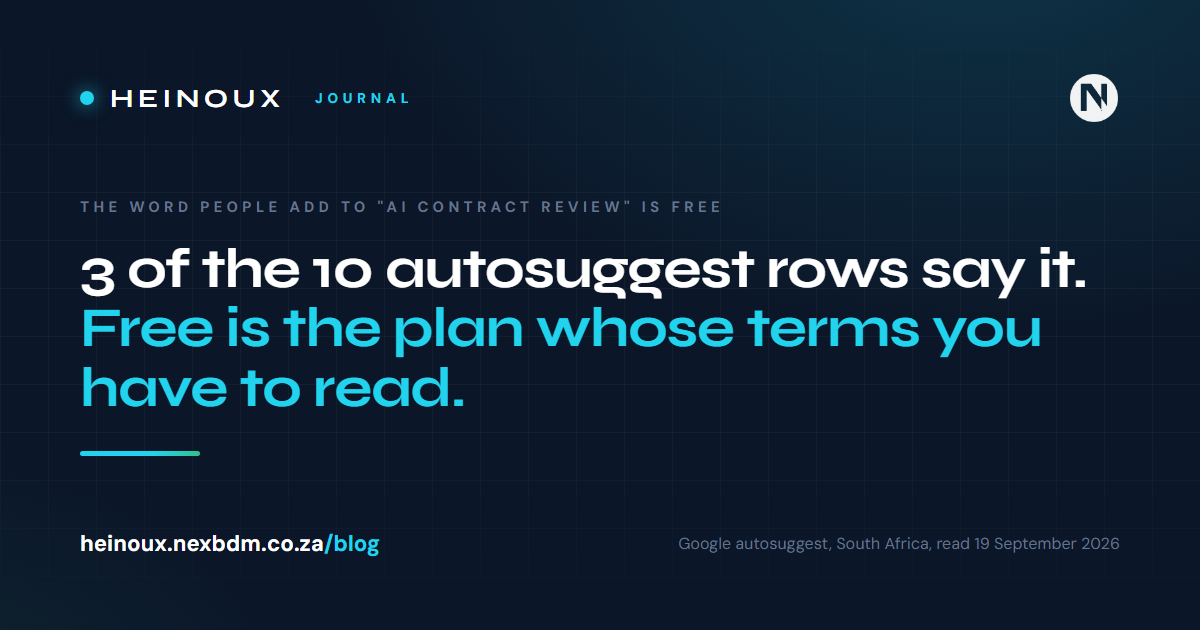
For "ai contract review" the ten came back like this: the head term, then "tool", then "free", then "tool free", then a tail of "australia", "reddit", "free online", "construction", "prompt" and "github". Four of the ten are the live, high-confidence kind. Two of those four say free. Three of the ten do.
So the person searching is not a law firm evaluating a platform. It is someone with an agreement in front of them, probably from the other side, who wants a model to read it and does not want to pay for the privilege. That is a small business owner. It is me, most weeks. And "free" is the word that decides which terms of service apply.
What free costs
I read the three providers' pages this morning, the current ones, not a summary of them.
OpenAI's enterprise privacy page says the business plans and the API are not used for training by default. The same page, a few paragraphs down, lists where training data comes from and includes "data from versions of ChatGPT and other services for individuals". The free plan is a service for individuals.
Anthropic's Commercial Terms, effective June 2025, say it "may not train models on Customer Content from Services". That is the business side. The consumer update from August 2025 gives Free, Pro and Max users a choice, and attaches a number to it: five years of retention if the setting is on, thirty days if it is off.
Google's Gemini privacy hub is the plainest of the three. "Please don't enter confidential information that you wouldn't want a reviewer to see or Google to use to improve our services." A subset of chats goes to human reviewers, and the ones that were reviewed are kept for up to three years even after you delete them.
None of that is hidden. All of it is on the page. The point is that the sentence everyone repeats, "they don't train on your data", is true of the plan the searcher is not on.
The clause nobody reads first
The part that surprised me was not in any provider's terms. It was in my own paperwork. The mutual NDA I send to every counterparty says that "Neither party shall disclose Confidential Information to any third party without prior written consent" and that each party "shall restrict access to Confidential Information to personnel who need to know it". The exclusions are the usual four: already public, already known, independently developed, required by law. There is no carve-out for service providers, and a model provider is not personnel.
Which means that if a counterparty pasted the documents I send them under that NDA into a free chat tool to check them, they would be in breach of it. And if I did the same with theirs, so would I. The provider's privacy page cannot fix that. Only the other side can, by consenting, or you can, by reviewing the clauses you need with the names and figures taken out.
I wrote that clause. I had not put it next to the upload button until this morning.
The rule I wrote down today
I run this business on written rules, because a rule in a file gets checked and a rule in my head gets forgotten on a busy Friday. This one went into the engine's standing rules before the post went out, so the claim that it exists is true on disk and not just in this paragraph.
- No agreement goes into a model until I have read its confidentiality clause and confirmed the upload is not a disclosure it forbids.
- The tool it goes into is on business terms, or has the training setting off, and I have checked which on the day, not from memory.
- Whatever the review does not need is removed first: ID numbers, addresses, bank details, signatures, and the names if the clause requires it.
- Every finding comes back as a quote with a clause number. A finding without a quote is a guess.
Four lines. They cost nothing and they would have caught the mistake I was one busy afternoon away from making. The business post has the full checklist and the sources; this is the founder's version, which is shorter because I only had to convince one person.
Chat soon.