The calendar's working title for today was "the decision tree I use when a client asks for AI and does not need it". That title describes conversations, and a journal entry should rest on something I can point to. So this is the decision tree itself, written down, with the one place I can prove I use it.
The four questions
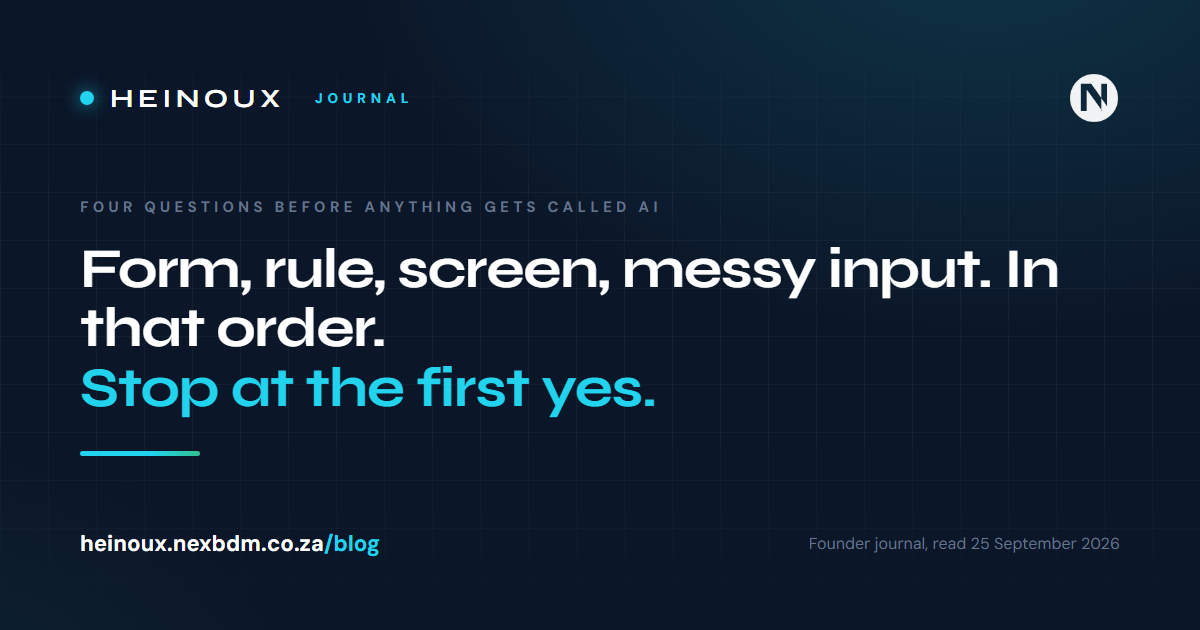
Today's business post is RPA vs AI, and its middle is four questions, asked in order, stopping at the first yes:
- Could the data be captured in a form at the start?
- Can the rule be written down in one sentence?
- Is the only way into the system through its screen?
- Does the input arrive in shapes nobody controls?
A yes at 1 or 2 means no AI and no robot, just a form and a rule. A yes at 3 means a robot copying through a screen. Only a yes at 4 means a model, and even then the model sits at the edge, turning messy input into fields, with a person checking what it produced.
Why the order matters
The order is the whole point. If you start at question 4, everything looks like it needs AI, because everything arrives messy when nothing captures it properly. If you start at question 1, most of the mess disappears before anyone has to read it.
I wrote about the same idea from another angle in automation has a dependency order: capture first, then reuse, then route, then remind, then report. The four questions are that order, asked about a single process.
Where I can prove I use it
The checks that run before this post publishes. Every one of them is a rule: a script that searches the text for characters and words that must not appear, counts the words in the opening answer, and confirms every quoted sentence exists in the source page it came from. None of those checks is AI. Each one fails loudly, the same way every time, and when one fails I know exactly which line to fix.
The writing is where a model helps, because a blank page is the messiest input there is. The rules sit around it. That is question 4 with the edge in the right place: the model does the reading and drafting, and rules decide whether it ships.
The line for today
Anthropic's own documentation for its screen-operating AI says it "might make mistakes or hallucinate" and advises isolating it "from sensitive data and actions". I like a vendor that says that plainly. It is also the best argument for asking the four questions in order: the cheapest AI step is the one a form made unnecessary.
If you want the longer version of why I think this way, it is in why every SME needs an ops autopsy before buying AI.
Chat soon.