Today's post on the business side of the site is about process mapping. Before writing it I checked what people actually type when they search for it, and the list surprised me a little.
What the search showed
I searched Google for "process mapping" with South Africa as the location. Fifteen suggestions came back. Most were about the drawing: symbols, shapes, levels, diagram, methodology, techniques. There was a course, and even a game. The rest were tools, templates and software.
Not one of them was about what you find when you do it.
Why that stayed with me
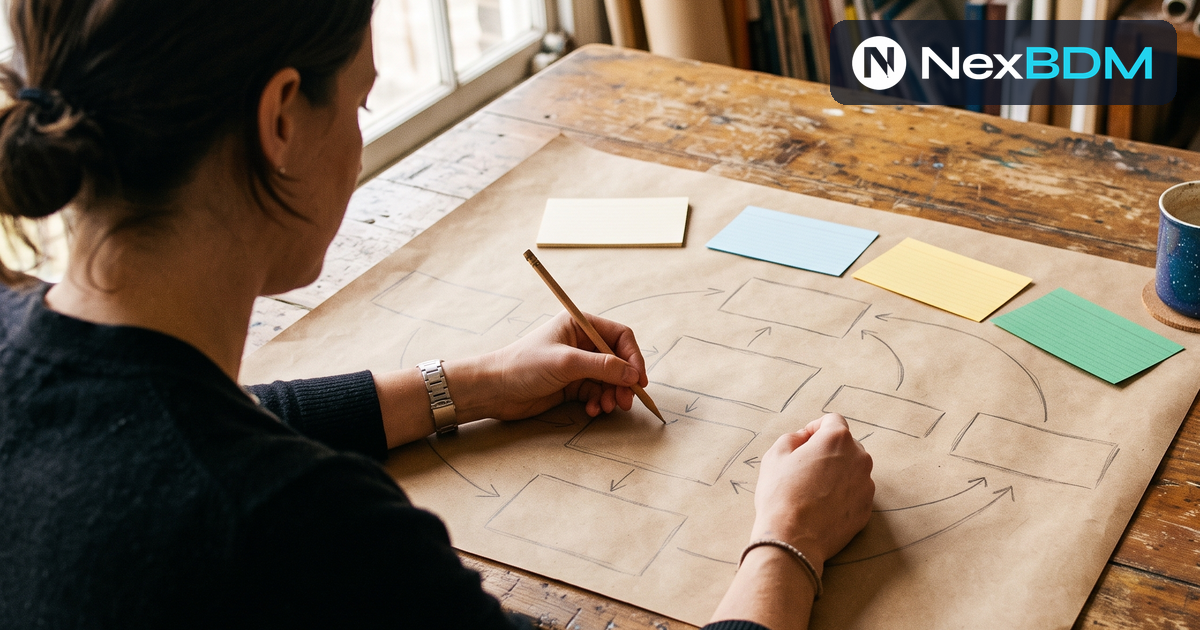
When we map a business, the shapes are the least interesting part. The method on our own site says it plainly: we sit with the people who do the work and draw how a lead becomes an invoice today. That drawing is usually rough. Cards, arrows, a few colours.
What matters is what the rough drawing shows. Where a quote waits. Where a customer's details get typed in again. Which step happens "when someone remembers". Those marks are the real result, and no template or symbol set will find them for you. Only the people doing the work can.
I think the search list says something honest about how mapping gets taught. It is treated as a notation skill. In a small business it is a listening skill.
What I take from it
If you map your own process this week, skip the symbol chart. Pick one journey, sit with the person who does it, and mark the waits. That is the part the Business OS is built around: the map comes first, and the system follows the map. If you want help seeing where your own work stalls, the free Business Autopsy is the start. Today's business post walks through it step by step.
Frequently Asked Questions
What did the search show about process mapping?
Most of the fifteen suggestions for "process mapping" were about notation: symbols, shapes, levels and diagrams, plus tools, templates, a course and a game. None were about what a map reveals once it is drawn.
Why are the symbols not the point?
A small business gets value from what the map shows: where work waits, what is typed twice and which steps nobody owns. A rough drawing made with the people who do the work finds those things.
How does this connect to the Business OS?
The Business OS is built around a map of how work really moves, drawn with the team first. The system then follows that map, so it removes the waits and repeats the drawing exposed.